

We use strictly necessary cookies to run this website, and optional cookies to improve performance and measure visits. Read our Cookie Policy and Privacy Policy.
ON THIS PAGE
- What does it cost?
- The 2026 rate card
- The three core formats
- Every format explained
- Why mobile billboards work
- B2B, events & competitors
- What moves the price
- What budgets can buy
- How I would plan the route
- What makes the creative work?
- Choosing the right format
- Measuring mobile OOH
- What I would avoid
- Right for an SME?
- FAQs
Core formats: Standard AdVan (20sqm) · Electric AdVan (20sqm) · XL AdVan (35sqm)
I’ve run enough AdVan and mobile billboard campaigns to know that the biggest mistake is treating them like a billboard that happens to have wheels.
The whole point of mobile billboard advertising is that you can take the campaign to the audience.
You can put a branded vehicle outside London’s advertising agencies, move through a busy shopping district, target a specific postcode, build a route around an event or change the campaign geography at different times of the day.
That changes how you plan the media. With a traditional billboard, you buy the site. With an AdVan, you are buying the combination of vehicle, route, timing and audience. Get those four things right and a focused mobile campaign can create a level of visibility that is difficult to achieve through a fixed site alone.
I’ve seen this work particularly well for brands with a very clear audience or a very specific reason for being somewhere. It is why I think mobile billboards are particularly interesting for B2B campaigns, challenger brands, product launches, retail and events.
There is also a lot of nonsense written about this part of the OOH market. You will often see huge audience numbers with little explanation, or a headline price that looks cheap until you find out what is actually included.
So this guide is about the practical side of AdVan and mobile billboard advertising: what it costs, the different vehicle options, where I would use them, what different budgets can realistically buy and when mobile OOH makes more sense than a fixed billboard.
These are the questions I would ask before putting a campaign on the road.
How much does mobile billboard advertising cost in the UK?
Loud! OOH's current published Digital AdVan rates start from £595 per regional operating day and £695 per London operating day. Three-day campaigns start from £1,595 regionally and £1,895 in London. Five-day campaigns start from £2,495 regionally and £2,995 in London.
From £595
Regional operating day
Digital AdVan · published rate
From £695
London operating day
Digital AdVan · published rate
From £1,500
Electric Digital AdVan per day
Premium electric mobile format
8 hours
Operating day with planned route
Included in every day rate
20sqm
Standard & Electric surface
XL increases this to 35sqm
From £2,495
Five-day regional campaign
£2,995 in London
Electric Digital AdVan activity is currently published from £1,500 per day. Final pricing depends on the vehicle, geography, availability and campaign requirements.
These are planning figures, not a promise that every campaign will trade at the same price. Vehicle type, operating hours, mileage, route requirements, campaign duration and specialist production can all affect the final cost.
The 2026 mobile billboard rate card:
Media cost only, excluding VAT unless stated – published openly, no mark-up. Full detail on the Digital AdVan pricing page.
2026 Mobile Billboard Rate Card
| Activity | Regional | London | What it gives you |
|---|---|---|---|
| Digital mobile billboard · 1 day | from £595 | from £695 | 8-hour operating day and planned route |
| Digital mobile billboard · 3 days | from £1,595 | from £1,895 | Short campaign burst |
| Digital mobile billboard · 5 days | from £2,495 | from £2,995 | Sustained weekly presence |
| Electric Digital AdVan | from £1,500 / day | from £1,500 / day | Premium electric mobile format |
All prices are indicative 2026 media costs, excluding VAT unless stated. Production and specialist requirements may be additional. Final availability and route requirements are confirmed at booking. Source: Loud! OOH pricing page.
With a traditional billboard, you buy the site. With an AdVan, you are buying the combination of vehicle, route, timing and audience.
The three core mobile billboard formats:
All figures below are indicative of a 8-hour per day media cost, excluding VAT.
Read More Detail ↓
The format should follow the campaign rather than the other way around. I would start with the audience and objective, then decide how much physical presence is actually needed.
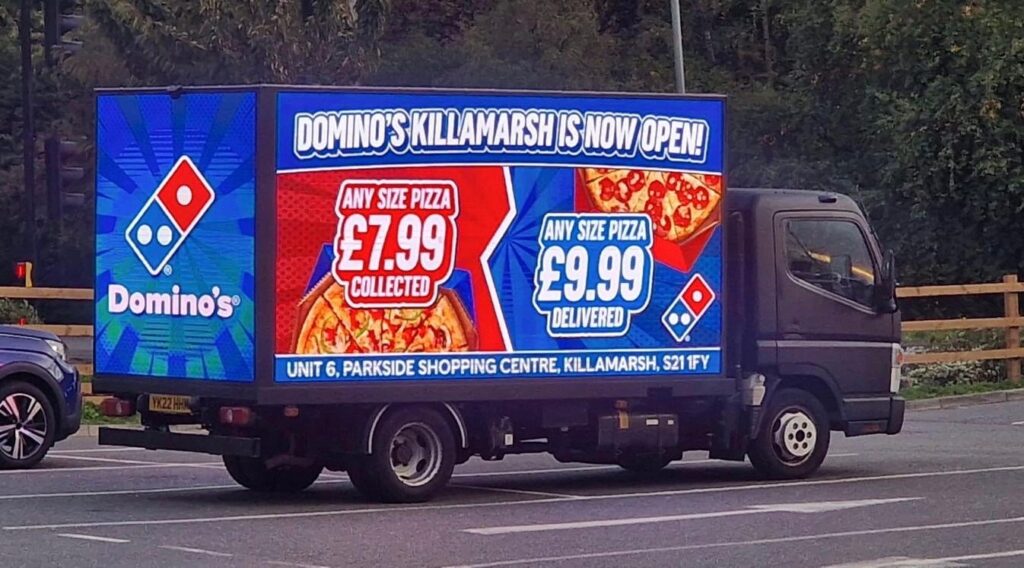
Core format
Standard AdVan | 20sqm
The Standard is the format I would normally look at first when the brief is about targeted mobile visibility rather than maximum physical scale. At 20sqm, there is enough advertising surface to create a strong presence while keeping the campaign flexible. I would keep the creative simple. The vehicle may be seen for only a few seconds, so large branding, a strong visual and one clear message will normally work harder than a wall of copy.
Surface
20sqm
Rate
From £595 / regional day
London
From £695 / day
Best for
Local awareness, B2B targeting, retail, launches and campaigns built around a defined route.
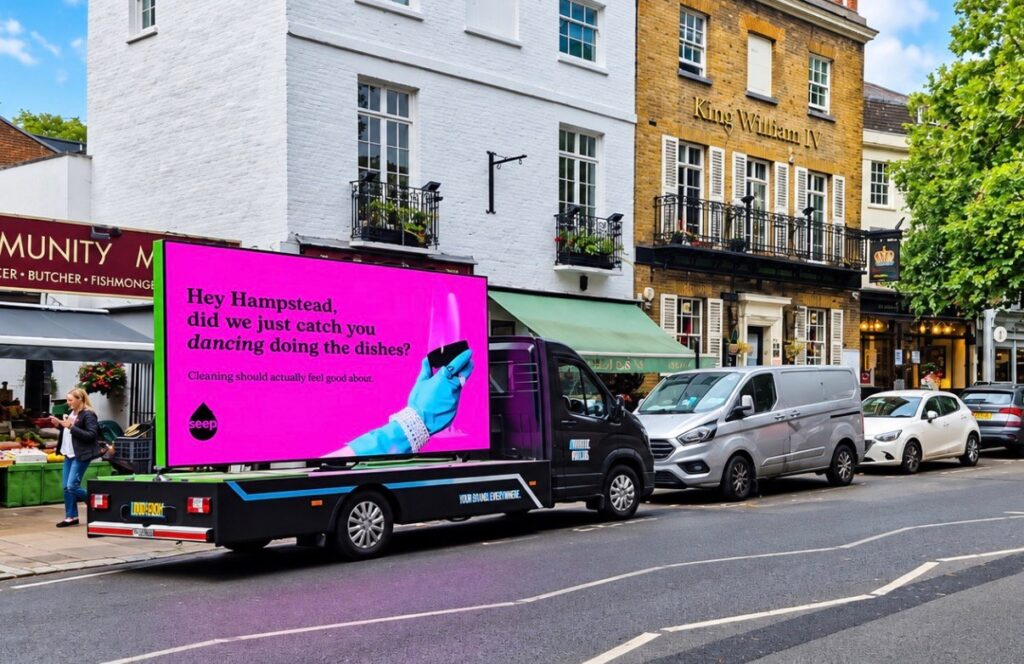
Premium
Electric mobile billboard | 15sqm
The Electric format keeps the 15sqm advertising footprint but uses an electric vehicle platform. I see this as a premium option rather than simply another version of the Standard. It is particularly relevant when the vehicle itself supports the brand positioning or when the campaign is operating in an urban environment where a premium electric platform makes sense. I would still start with the audience. Choosing an electric vehicle should support the campaign strategy, not replace it. Any environmental claims should be specific and properly evidenced.
Surface
15sqm
Rate
From £1,500 / day
Platform
Electric vehicle
Best for
Brands whose positioning the vehicle supports, and premium urban environments.
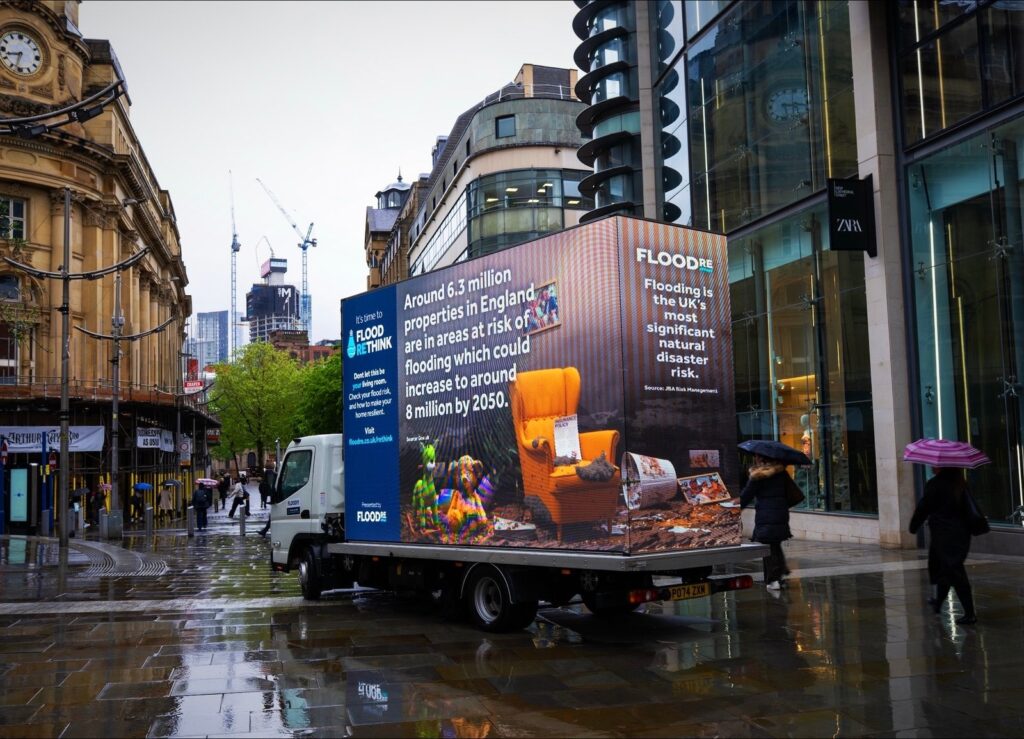
Maximum scale
XL mobile billboard | 35sqm
The XL is the format I would use when physical presence is the priority. At 35sqm, it gives the creative a much larger canvas and is particularly suited to major launches, entertainment, retail, automotive and campaigns where the vehicle needs to be noticed from further away. But bigger is not automatically better. If the audience is tightly concentrated, a well-routed 20sqm vehicle can be a smarter buy than a larger vehicle travelling broadly.
Surface
35sqm
Rate
From £800
Pricing
Depends on vehicle & geography
Best for
Major launches, entertainment, retail, automotive and campaigns needing distance visibility.
Format rule: The format should follow the campaign rather than the other way around. Start with the audience and objective, then decide how much physical presence is actually needed.
Why mobile billboards work:
I think mobile OOH is at its best when there is a reason for the vehicle to be somewhere.
Read More Detail ↓
That could be a business district full of the people you want to reach, a retail catchment, a competitor location, a product launch, an exhibition, a sporting event or a particular city-centre audience.
The route becomes part of the media plan. That is the big difference between a fixed billboard and a mobile billboard.
Mobile billboards vs traditional billboards
A traditional billboard is fixed. That is a strength when you want consistent visibility from the same audience over a long period. Mobile billboards give you something different: the geography can change, the route can be built around a specific audience and the campaign can concentrate activity around a particular time or event. I would choose the fixed site when sustained location-based presence is the priority. I would choose mobile OOH when timing, geography or audience concentration is important. Sometimes the strongest campaign uses both.
B2B, events and competitor targeting:
Three situations where a mobile billboard becomes a very targeted piece of OOH rather than just another awareness channel.
B2B and agency targeting
This is one of the areas where I think mobile billboard advertising is particularly underused.
London has dense clusters of media agencies, creative agencies, technology businesses, professional services firms, plus lots more.
If the audience is the people working in those businesses, I would rather build a route around the relevant office clusters than buy broad London coverage simply because it looks impressive on a media plan.
Events and launches
Events create temporary concentrations of people, which makes them a natural fit for mobile OOH.
I would look at the whole journey, not just the venue.
Where are people travelling from? Which stations and transport hubs will they use? Where are the hotels and surrounding entertainment areas? The route can then be built around those movements before, during and after the event.
Competitor targeting
One of the more creative uses of a mobile billboard is geographical competitor targeting. A vehicle can be routed around competitor offices, stores or business districts.
For challenger brands, that can create a very direct physical presence without requiring a huge market-wide budget. I would still make sure the route has a genuine audience rationale.
Driving past a competitor once is a stunt. Building a repeatable route around the relevant audience is media planning.
What moves the price?
The main variables are vehicle type, campaign duration, geography, operating hours, mileage, route complexity, availability and any bespoke production.
01
Geography
London versus regional
London can cost more than regional activity because of operating conditions, demand and route planning.
02
Duration
Campaign length and fleet size
Longer campaigns can improve the effective day rate. Multi-vehicle campaigns can also change the economics.
03
Vehicle
Vehicle type and operating requirements
Vehicle type, operating hours, mileage, route complexity and availability all affect the final cost. Final pricing depends on the vehicle, geography, availability and campaign requirements.
04
Production
Bespoke production
Keep media and production separate when comparing campaigns. A standard digital execution and a bespoke experiential build are completely different cost propositions.
Comparing quotes: Keep media and production separate. A standard digital execution and a bespoke experiential build are completely different cost propositions.
What can different budgets actually buy?
Four honest levels, from a focused single day to coordinated fleets and multi-location strategies.
Under £1,000
Single day
A focused single-day campaign
A focused single-day Digital AdVan campaign is realistic at Loud! OOH's published starting rates. This can work for a launch, opening, event or concentrated moment.
£1,500 – £3,000
Burst
A short campaign burst
A short burst becomes possible, with three-day or selected five-day activity depending on geography and vehicle requirements.
£3,000 – £10,000
Sustained
Sustained activity or multiple vehicles
Sustained mobile billboard activity, multiple vehicles or a more developed route strategy becomes realistic.
£10,000+
Fleet
Coordinated fleets and premium formats
This is where coordinated fleets, XL vehicles, premium electric activity, longer campaigns and multi-location strategies become more interesting.
How I would plan the route
I would never start by asking where the vehicle can go. I would start by asking where the audience is.
Read More Detail ↓
Then I would split the day into useful windows. Morning business activity can be very different from lunchtime retail activity or evening entertainment.
Recruitment campaigns
A recruitment campaign might need business districts and universities.
Retail campaigns
A retail campaign might need shopping areas and transport hubs.
B2B campaigns
A B2B campaign might need office clusters.
Event campaigns
An event campaign needs the venue and the routes people take to get there.
The route should follow the brief, not the other way around.
What makes the creative work?
Mobile billboard creative needs to be understood quickly.
Read More Detail ↓
I would keep the brand large, the message short and the visual strong. If there is a URL, QR code or call to action, it needs to be genuinely usable from the environment in which the vehicle is being seen.
The biggest mistake is treating the side of a vehicle like a website. It is not. The vehicle is the media environment and the creative has to work at speed, at distance and from different viewing angles.
How do you measure mobile OOH?
I would look beyond clicks.
Read More Detail ↓
Useful measures include estimated audience, impacts, route completion, GPS reporting, photographic proof, geographic delivery, frequency, website traffic, branded search, QR scans, campaign-specific landing pages, promo codes, leads and social activity.
Measuring mobile OOH
| Measure | What it tells you |
|---|---|
| Estimated audience & impacts | The modelled scale of who saw the vehicle on its route |
| Route completion & GPS reporting | Proof of where the vehicle actually travelled |
| Photographic proof | Visual evidence of the campaign in the planned environment |
| Geographic delivery & frequency | Whether activity concentrated where the audience is |
| Website traffic & branded search | Uplift in direct and search interest during the campaign |
| QR scans, landing pages & promo codes | Direct response attribution where the creative carries a call to action |
| Leads & social activity | Commercial outcomes and earned pickup |
For an awareness campaign, I would not expect every person who sees the vehicle to scan a QR code. The job of OOH is often to build memory and salience first, with search, social, PR and other channels picking up the response.
Is mobile billboard advertising right for an SME?
Straight answer: Yes, provided the campaign is focused.
I would not tell a small business to spend its entire budget driving around an entire city. I would define the audience, identify the strongest locations and build the route around them.
That can make a relatively modest budget feel much bigger because the campaign is concentrated rather than diluted.
What I would avoid
Six mistakes that quietly waste mobile budgets.
01
Planning
Putting a vehicle on the road without a route strategy
I would avoid putting a vehicle on the road without a route strategy.
02
Routing
Choosing a route because it looks busy
I would avoid choosing a route because it looks busy rather than because the audience is relevant.
03
Creative
Overloading the creative
I would avoid overloading the creative. The vehicle may be seen for only a few seconds.
04
Coverage
Assuming one vehicle provides blanket city coverage
I would avoid assuming that one vehicle provides blanket city coverage.
05
Claims
Environmental language that cannot be substantiated
I would avoid environmental language that cannot be substantiated. Any environmental claims should be specific and properly evidenced.
06
Format
Paying for an XL when a Standard would work harder
I would avoid paying for an XL when a Standard 20sqm campaign would put the message in front of a better audience.
Final thoughts
Mobile billboards are not a gimmick. They are a practical OOH format when the campaign has a clear reason to be somewhere.
The biggest advantage is not simply that the billboard moves. It is that the media plan can move with the audience.
Start with the audience. Then the objective. Then the geography. Then the vehicle. Then the creative.
That is how I would plan a mobile billboard campaign, and it is how I think brands get much more from mobile OOH.
At Loud! OOH, we plan and buy AdVan and mobile billboard campaigns across the UK, from focused local activity to multi-vehicle London campaigns. We publish clear media costs and build campaigns around the audience rather than simply selling available space.
Frequently asked questions
How much does a mobile billboard cost in the UK?
Loud! OOH’s current published Digital AdVan rates start from £595 per regional operating day and £695 per London operating day. Three-day campaigns start from £1,595 regionally and £1,895 in London, while five-day campaigns start from £2,495 regionally and £2,995 in London. Every rate is published on our 2026 pricing page.
What are the three AdVan formats?
The core formats are Standard at 20sqm, Electric at 20sqm and XL at 35sqm.
What is the difference between Standard and XL?
The Standard has a 20sqm advertising surface. The XL has a 35sqm surface and is designed for campaigns where additional physical presence is important.
How much is an Electric AdVan?
Loud! OOH currently publishes Electric Digital AdVan activity from £1,500 per day. Final pricing depends on the campaign and vehicle availability.
Can mobile billboards target specific areas?
Yes. Route planning is one of the main advantages of mobile OOH. Campaigns can be built around business districts, retail areas, events, transport hubs and other relevant locations.
Are mobile billboards good for B2B?
They can be particularly effective for B2B because businesses and decision-makers are often geographically concentrated. Routes can be built around the areas where target businesses operate.
Do mobile billboard prices include production?
Production depends on the format and creative. Digital activity can avoid traditional print production, while static or bespoke vehicle branding may involve additional production costs.
Sources referenced in this article