Why We Put Our Own Money on a Billboard to Prove OOH Advertising is More Affordable Than You Think
We could have written a white paper. We could have built a slide deck, sent a newsletter, or posted a series of LinkedIn updates about why billboard advertising is more accessible than most small businesses think.
Instead, we bought two 48-sheet billboards on York Street in Leeds city centre and let them make the argument for us.
This is the full story behind that campaign — what it cost, what it proved, and why we think every SMEs in the UK should be seriously reconsidering outdoor advertising in 2026. First, the numbers that actually matter
The Campaign: Two Billboards, One Very Public Price Comparison
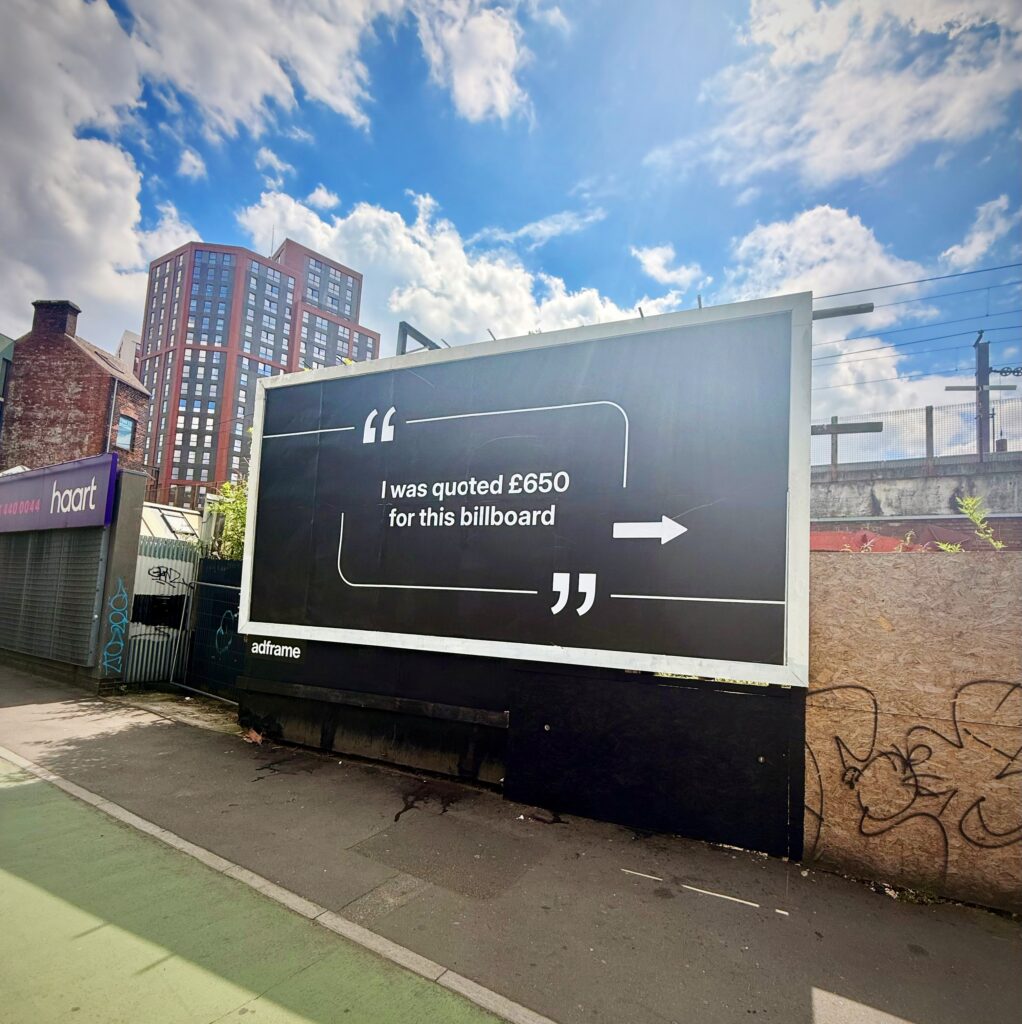
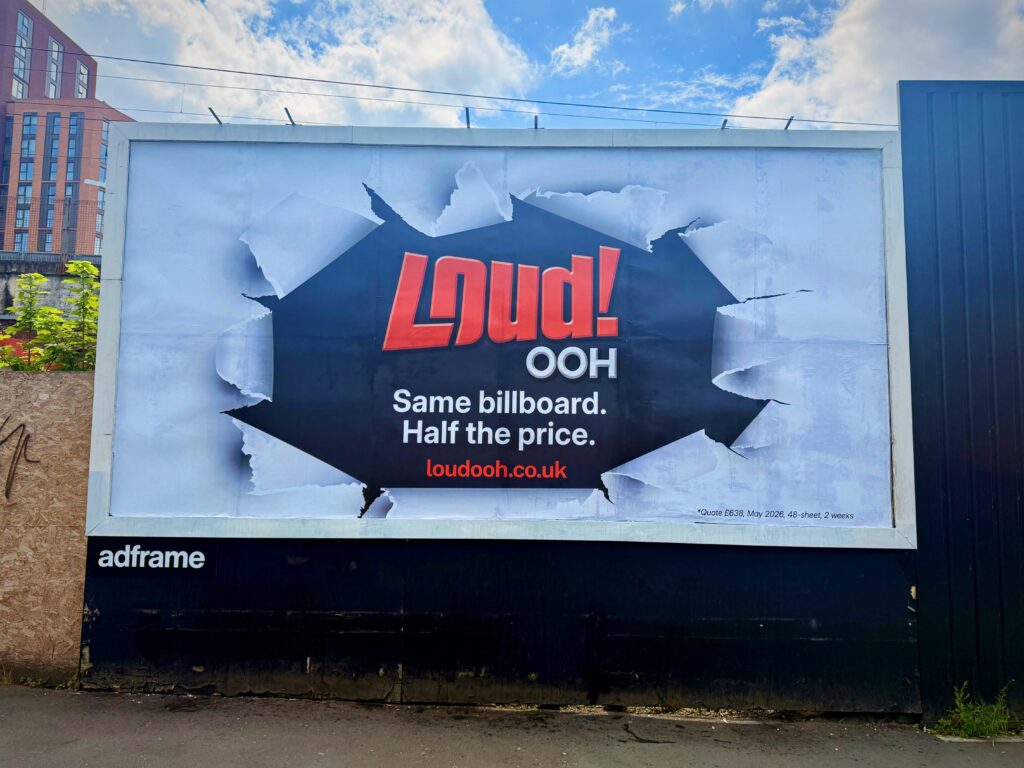
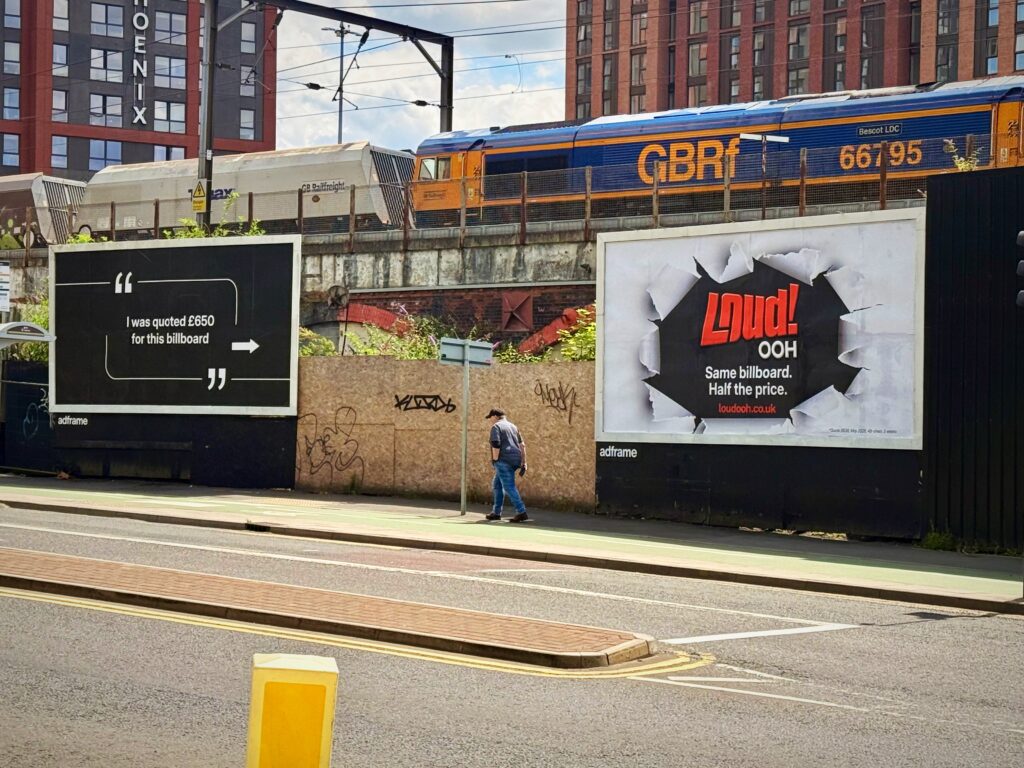
In June 2026, two adjacent 48-sheet hoardings went up on York Street in Leeds. The first carried a simple customer quote: “I was quoted £650 for this billboard.” An arrow pointed to the second board, which answered back in bold: Same billboard. Half the price.
That second board cost £325 through Loud! OOH. Same format. Same location. Same two weeks of exposure. Anyone standing at the bus stop directly in front of both boards could see the comparison without doing anything more than looking left and right.
We chose York Street deliberately. It has a busy Metro bus stop right in front of the site, which means genuine dwell time — commuters, shoppers and workers standing still, not driving past at 40mph. For a campaign built entirely around reading two boards and joining the dots, that dwell time is everything.
Why We Did It: The Ghosting Problem Nobody Talks About
Twenty years in the OOH industry teaches you a lot. One of the most consistent things it taught us is where the process breaks down for small businesses.
A business owner decides they want to explore billboard advertising. They search online. They find agencies. They fill in a contact form. They wait. Then comes the call, the brief, the back-and-forth — and days or sometimes weeks later, a quote arrives in their inbox. And then nothing. Ghosted.
“It happens constantly,” says Jamie Roberts, founder of Loud! OOH. “You build the rapport, you do the research, you go back with your recommendation and the client just disappears. Not because the price was wrong. Because by the time they got a number, they’d already lost momentum. The process killed it.”
The issue is not that billboard advertising is expensive. Most businesses are genuinely surprised by how affordable it is when they finally find out. The issue is finding out. The ring-us-for-a-quote model that most OOH agencies operate on filters out the very businesses that could benefit most from the medium — not because they cannot afford it, but because they do not have the time or the appetite for a sales process just to get a number.
At Loud! OOH, we publish our pricing openly at loudooh.co.uk/pricing. Billboards, digital screens, bus advertising, London Underground, airports — all of it, with real numbers, before anyone has to speak to us. The York Street campaign is the most direct way we could think of to demonstrate that we mean it.
The UK OOH Market in 2026: Bigger Than Most People Realise
Before we get into what outdoor advertising actually costs, it is worth understanding why the medium matters in the first place.
UK out-of-home advertising reached £1.44 billion in 2025, a record according to Route and
PwC. Digital OOH now accounts for 67% of all OOH revenue, up from 32% in 2015, and is forecast to reach 75% of revenue by 2027.
This is not a medium in decline. It is one of the fastest-growing advertising channels in the UK, and the effectiveness data backs up why
Key UK OOH Statistics for 2026
| Metric | Figure | Source |
| UK OOH market revenue (2025) | £1.44 billion (record) | Outsmart / PwC |
| Forecast revenue growth (2026) | +4.1% to £1.471bn | Talon OOH |
| DOOH share of total OOH spend | 67% | Route |
| Average ROI per £1 spent | £1.60 | Route / IPA |
| Ad recall within one month | 79% | Route |
| UK consumers who trust OOH ads | 58% | Talon OOH |
| UK population who see OOH weekly | 98% | Outsmart |
| Consumers who take action after seeing OOH | 79% | Outsmart |
| UK advertisers increasing brand spend in 2026 | 37% | Talon OOH |
| Consumers who find personalised digital ads off-putting | 57% | Talon OOH |
| Consumers who view DOOH ads favourably | 73% | Talon OOH |
58% of consumers trust OOH advertising, and trust continues to rise year on year, at a time when confidence in many other channels is declining. OOH is stepping into the trust vacuum and becoming a crucial anchor for credibility.
That trust gap matters. While 57% of British consumers find hyper-personalised digital ads off-putting, 73% view DOOH ads favourably. OOH occupies a unique position: it is contextual without being invasive, visible without being interruptive.
For a small business trying to build brand recognition in a specific town or city, the argument for outdoor advertising is genuinely compelling. It cannot be skipped, blocked or scrolled past. It is just there, working, every single day.
What Billboard Advertising Actually Costs in the UK in 2026
This is the section most agencies make you wait for. We will just tell you.
Billboard Advertising Costs by Format (2-week campaign, media cost only)
| Regional | London | London | ||
| Format | Description | UK | (Outer) | (Central) |
| 6-sheet | Bus shelter / small panel | From £150 | From £300 | From £500 |
| 48-sheet | Large roadside billboard | From £325 | From £700 | From £1,500+ |
| 96-sheet | Largest roadside format | From £600 | From £1,200 | From £2,500+ |
| Digital 6-sheet | Bus shelter digital screen | From £200 | From £400 | From £600+ |
| Digital roadside | Large digital billboard | From £400 | From £800 | From £2,000+ |
All prices are media cost for a standard 2-week cycle. Print (approx £50-£150 per skin for static formats) and VAT are additional. Digital formats do not require print costs.
The North vs London Price Gap
The same 48-sheet site costs about 44% less in Manchester, Leeds or Birmingham than in London, and up to 50% less in the cheapest major cities. The budget for one London campaign can buy two regional cities of coverage instead.
That gap is significant for any SMEs with a regional audience. A business operating in Leeds,
Manchester, Sheffield or Liverpool is paying roughly half what a London-based brand pays for equivalent reach in their own market.
What Else Goes Into the Total Cost?
The media cost is the biggest line item, but a realistic budget also includes:
| Cost Element | Typical Range | Notes |
| Media cost (48-sheet, 2 weeks, regional) | £325 – £600 | Varies by location and demand |
| Print / artwork production | £50 – £150 per skin | Not required for digital |
| Creative design | £200 – £500 | Some agencies include this |
| VAT | 20% on all above | Standard rate |
| Installation | Usually included | Confirm with your agency |
A realistic all-in budget for a single 48-sheet billboard campaign in a Northern UK city centre, including design and print: £600 to £900 for two weeks.
That is within reach for most small businesses with any kind of marketing budget
OOH vs Digital Advertising: How Do They Compare?
A question we get asked often is how billboard advertising compares to digital channels on a cost and effectiveness basis. The honest answer is that they serve different purposes — but the comparison is more favourable to OOH than most digital-first marketers assume.
OOH vs Digital: A Side-by-Side Look
| Factor | Billboard OOH | Social Media Ads | Google Search Ads |
| Can be skipped or blocked | No | Yes | Yes |
| Audience reach (weekly) | Up to U8% of UK population | Dependent on budget | Dependent on budget |
| Average ROI per £1 | £1.60 | Varies | Varies |
| Ad recall after 1 month | 79% | Low (est. 20- 30%) | Low |
| Consumer trust | 58% trust OOH | Lower and declining | Lower and declining |
| Minimum viable budget | £325 (media cost) | Any amount | Any amount |
| Brand credibility signal | High | Low | Low |
| Cannot be turned off overnight | Yes | No | No |
The key advantage OOH has over digital is permanence and trust. A billboard cannot be turned off, paused or outbid by a competitor overnight. It builds what marketers call mental availability — the kind of low-level brand familiarity that makes a business feel established and credible to anyone who passes it repeatedly.
For a small business launching in a new area or trying to establish local presence, that credibility signal is genuinely hard to replicate through digital channels alone
What OOH Advertising Can Do for an SMEs in Practice
The most common misconception we hear from small businesses is that OOH is purely a brand-building tool for companies that are already well known. That is not how it works in practice.
A well-placed billboard or OOH campaign can:
Drive direct footfall — a 48-sheet on a route into a town centre pointing people toward a new restaurant or retail location is a straightforward performance campaign, not just a branding exercise.
Support a product launch or event — two weeks of billboard presence around a specific date is highly targeted and cost-effective.
Build local brand recognition faster than digital — repeated exposure on a commuter route or high street builds brand familiarity in a way that a Facebook ad that gets scrolled past simply cannot.
Lend credibility to a new business — there is a reason people assume a business they have seen on a billboard is more established than one they have only seen on social media. Size matters in the physical world.
Generate PR and social media content — our own York Street campaign attracted attention from industry press, local businesses and passers-by who photographed and shared the boards. The OOH campaign became a digital campaign at no extra cost.
OOH Formats: Which One Is Right for Your Business?
Not every business needs a 48-sheet roadside billboard. The UK OOH market offers a range of formats that suit different budgets, objectives and audiences.
OOH Format Guide for SMEs
| Format | Best For | Average Budget (2 weeks) | Reach |
| 6-sheet (bus shelter) | Hyper-local targeting, footfall, retail | £150 – £300 | Pedestrians and local traffic |
| 48-sheet billboard | Brand awareness, local and regional campaigns | £325 – £700 | Roadside drivers and pedestrians |
| 96-sheet billboard | High-impact brand campaigns | £600 – £1,500 | High traffic roadside |
| Bus advertising (rear) | Local awareness across a town or city | £200 – £500 per bus | Broad local audience |
| Digital 6-sheet (DOOH) | Targeted, flexible, time-sensitive campaigns | £200 – £500 | Pedestrians at transport hubs |
| London Underground | National brand campaigns, commuter audiences | £500 – £2,000+ | ABC1 commuters |
| Airport advertising | Premium brand, business travel audience | £1,000+ | High-value travellers |
Billboards represented 39.96% of the United Kingdom OOH and DOOH market in 2025, yet transit inventory is expanding fastest at 4.38% a year as contracts with Transport for London and Network Rail pump more than 1,000 new screens into stations.
For most SMEs starting out with OOH advertising, a 48-sheet billboard or 6-sheet bus shelter campaign in their local area is the most cost-effective starting point. It delivers proven reach at a budget that does not require a six-figure marketing spend to justify
How to Plan Your First OOH Campaign
If you have never run an outdoor advertising campaign before, the planning process is
simpler than most agencies make it appear.
Step 1: Define your objective Are you trying to build brand awareness in a specific area, drive footfall to a location, support a product launch, or create a local presence? The objective determines the format, location and duration.
Step 2: Set a realistic budget A starting budget of £500 to £1,000 all-in (including media, print and design) is achievable for a regional 48-sheet or a 6-sheet bus shelter campaign. Decide upfront what you are comfortable spending.
Step 3: Choose your location Think about where your target audience actually is. A restaurant advertising near a commuter route into the town centre. A gym near a leisure or retail park. A local retailer on the high street. Location is everything in OOH.
Step 4: Get your creative right Billboard advertising has approximately three to five seconds to make an impression on a passing driver. The copy should be short, the message should be single-minded, and the design should be readable at distance. Less is always more.
Step 5: Book with transparency Ask any agency you speak to for a clear breakdown of media cost, print, installation and any management fees before you agree to anything. If they will not give you a number without a discovery call and a formal proposal, that tells you something about how they operate.
At Loud! OOH, all of that information is at View Our Pricing before you have even spoken to us
What Running This Campaign Taught Us
We learned a few things from putting our own money on a billboard and making the price public.
The first is that the concept resonated immediately with small business owners. The number of people who stopped at that bus stop, looked at both boards and took a photo tells you something real about how frustrated SMEs have become with the opacity of agency pricing in the OOH industry. They were not surprised by the price difference. They were relieved someone had finally said it out loud.
The second is that OOH advertising genuinely works as a self-referential medium. Using the format itself to prove the value of the format is not a gimmick — it is the most honest demonstration you can make. We could not have made that argument on a podcast or in a blog post with the same impact.
The third is that transparency changes the conversation. From the moment we published our pricing online and then put it on a billboard, the enquiries we received were different in quality. People who contacted us already knew the numbers. There was no negotiation, no confusion, no time spent explaining what things cost. They had done their research and decided we were the right fit. That is what happens when you remove the friction from the process.
The York Street campaign will come down. The lesson it taught us about how small businesses want to engage with outdoor advertising will not.
If you are considering OOH advertising for the first time and want to understand what a campaign might cost for your business, our pricing page has real numbers for every format — no forms, no sales calls, no waiting.
About the Author
Jamie Roberts is the founder of Loud! OOH, an independent out-of-home advertising agency helping UK businesses get seen without the inflated costs that have traditionally come with the medium. With 20 years of experience planning and buying OOH campaigns across billboards, digital screens, bus advertising, London Underground and airports, Jamie launched Loud! OOH to bring genuine pricing transparency to a market that has historically made it difficult for smaller businesses to access.
Connect with Jamie on LinkedIn | loudooh.co.uk
Quote received May 2026, 48-sheet, 80 York St Leeds, 2 weeks. Market data sourced from Outsmart,
Route, Talon OOH, Mordor Intelligence and AA/WARC 2025/2026
As Featured In
Ads of the World –https://www.adsoftheworld.com/campaigns/we-didn-t-write-about-billboard-advertising-costs-we-put-them-on-a-billboard
Prolific North – https://www.prolificnorth.co.uk/news/new-leeds-ooh-agency-turns-to-ooh-unsurprisingly-for-launch-campaign/
Associated Press – https://apnews.com/press-release/ein-presswire-newsmatics/press-release-cc590396ee3db04e5f53460d147…
MSN – https://www.msn.com/en-us/money/other/loud-ooh-launches-with-leeds-billboard-price-challenge/ar-AA2…