
London Underground Advertising: A Real Guide to What It Costs, What Works, and Whether It Is Right for Your Business
Most guides to London Underground advertising read like they were written by someone who has never actually booked a campaign. You get impressive reach statistics, a vague mention of pricing, and then a form asking you to request a quote. Which rather defeats the purpose.
The Underground is a format I have worked with extensively, across budgets ranging from a few thousand pounds for a small brand testing the water, to multi-format campaigns across Zone 1 stations. I know where it works brilliantly. I know where the money gets wasted. And I know what nobody tells you upfront.
This is that guide.
We will cover every format, real 2026 pricing drawn from our own published rate card, how to pick the right stations, when it makes sense for an SME, and what to avoid. No forms. No vague ranges. Just honest information so you can make the decision yourself.
First, the numbers that actually matter
A lot of statistics get thrown around in guides like this. Let me focus on the ones that are genuinely useful for planning.
The London Underground carried 1.216 billion passenger journeys in 2024/25, according to Transport for London data. That is roughly 5 million journeys every single day across 272 stations.
In 2025, King’s Cross St Pancras was the single busiest station on the network, recording over 72.5 million entries and exits for the year. The contrast between that and somewhere like Roding Valley, which recorded just over 201,000 passengers in the same period, tells you everything about why station selection matters so much when you are planning a campaign.
The reach numbers are impressive. But reach alone does not tell the full story. What makes the Underground genuinely different from most OOH formats is the combination of reach and dwell time.
Passengers on the London Underground spend an average of around 20 minutes per journey on the network. They are not driving. They cannot scroll. In most zones, phone signal is limited or absent. Your ad is not competing with a phone screen.
That is a fundamentally different environment from a roadside billboard, where you have roughly two seconds of attention from a passing driver. Underground passengers are standing on platforms, sitting in carriages, walking through corridors. They look at things.
Key network statistics at a glance
| Metric | Figure | Source / Notes |
| Annual passenger journeys | 1.216 billion | TfL / Wikipedia 2025 data |
| Daily journeys (approx.) | 5 million+ | TfL network data |
| Number of stations | 272 | London Underground 2025 |
| Busiest station (2025) | King’s Cross St Pancras | 72.5 million entries/exits |
| Average dwell per journey | ~20 minutes | TfL journey data |
| Ad recall rate (prompted) | Up to 73% | TfL / industry research |
| ABC1 passenger share | 58 to 65% | Multiple industry sources |
| OOH ROI per £1 spent | £1.80 | Loud! OOH compiled data 2026 |
| Ad recall at 30 days | 79% | Loud! OOH compiled data 2026 |
Sources: Transport for London performance data | Wikipedia: List of busiest London Underground stations | Loud! OOH pricing page
Who actually uses the Tube? The audience question.
The Underground audience is not uniform. It shifts dramatically depending on the line, the station, the time of day, and the day of the week. Understanding this is genuinely the most important part of planning a campaign.
The broad demographic picture: the Underground skews toward professionals aged 25 to 44 with higher than average incomes. Multiple sources put the ABC1 share of regular Tube users at between 58% and 65%. London’s median salary is already higher than the rest of the UK, and Underground commuters skew higher still within that.
But ABC1 London professionals is quite a broad group. Let me make it more useful.
Lines and stations tell you more than general demographics
Morning rush hour at Bank or Canary Wharf is a completely different audience from a Sunday afternoon at Covent Garden. Financial district stations like Bank, Moorgate, and Canary Wharf skew heavily toward professional services workers. Research suggests over 70% of passengers at key financial stations hold professional qualifications. Useful if you are selling B2B services, financial products, or premium consumer goods.
Stations near universities, like Russell Square and Goodge Street, skew younger, with the 18 to 34 age group representing over 60% of passengers. Leisure destinations like Leicester Square and Covent Garden bring in more tourists, more weekend visitors, more discretionary spenders. South Kensington and Sloane Square tap into higher-income residential audiences.
Weekend traffic shifts dramatically, with tourists and leisure visitors making up as much as 45% of footfall at central London stations.
The practical implication: do not think about the Underground as a single media buy. Think about which stations, which lines, and which times of day actually put you in front of your specific audience.
I have seen brands book the cheapest available inventory and wonder why results were disappointing. The format worked fine. The audience was not there.
Every format explained. What they look like. What they cost.
The Underground has more advertising formats than most people realise. Here is an honest breakdown of each one, with pricing taken directly from the Loud! OOH 2026 rate card.
All prices are media costs for a standard two-week campaign unless stated. They exclude VAT and print production. Prices vary by zone, station category, and time of year. Zone 1 commands a significant premium over outer zones.
Tube car panels (TCP)
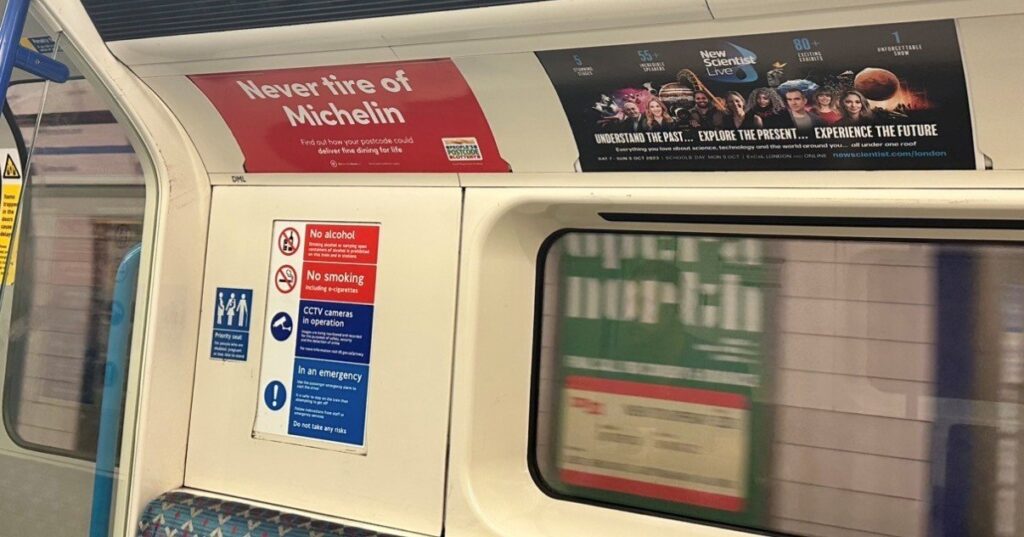
Horizontal poster strips inside train carriages, positioned above the seats and doors. Every passenger sitting or standing sees them. The average carriage journey lasts around 20 minutes, which is serious dwell time by any OOH measure. Tube car panels are booked by line rather than by individual station.
- Format: interior carriage strips, above seats and doors
- Price: from £10+ per panel (line-based pricing)
- Dwell time: 20 minutes average per journey
- Best for: detailed messaging, long copy, brand familiarity with regular commuters
Tube car panels are one of the few OOH formats where you are buying repeated exposure to the same person across multiple journeys. Regular commuters see your campaign every morning and evening for two weeks. That cumulative effect is genuinely different from most outdoor formats.
Escalator panels (LEP and DEP)
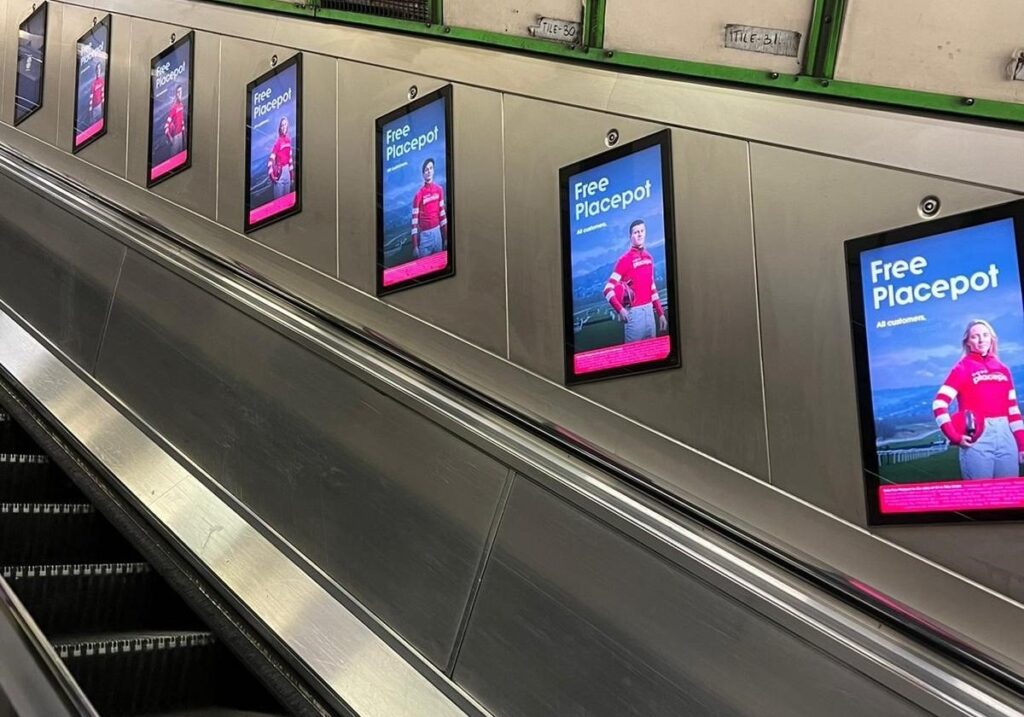
Sequential portrait panels running along escalator tunnels. Passengers travelling up or down see a run of panels, one after another, for the full escalator ride. Dwell time is 30 to 80 seconds depending on the station and escalator length. The audience is captive in the truest sense.
- Price: from £125 per panel
- Zone 1 major interchanges: £300 to £600 per panel and above
- Minimum booking: typically one full escalator run (multiple panels)
- Best for: sequential storytelling, campaigns with a narrative, brands with strong creative confidence
Escalator panels consistently produce the highest recall rates of any Underground format. When you book a full run, each panel can carry a different part of the message. Done well, it is genuinely memorable. A properly executed escalator campaign also tends to generate organic social media photography, which extends the reach beyond the network itself.
4-sheet platform posters
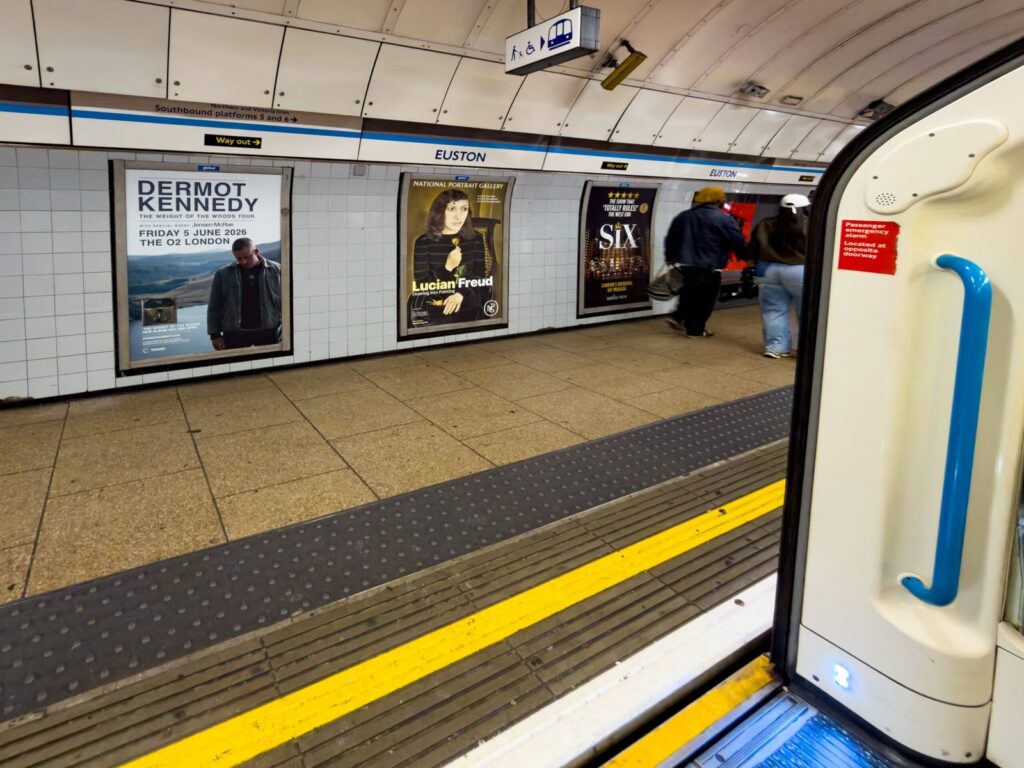
Static posters along platform walls, at direct eyeline of passengers waiting for trains. Natural dwell time is 2 to 5 minutes while waiting. Passengers are stationary, facing the poster, with nothing competing for their attention.
- Price: from £300 per panel at Zones 4 to 6
- Zone 1 stations: £400 to £600 per panel
- Backlit finish, clean presentation
- Best for: brand awareness, product launches, campaigns where readability matters
Outer zone platform posters offer excellent value for brands that do not need Zone 1 coverage. The audience is still substantial, the format is high quality, and the cost is a fraction of premium central London inventory.
16-sheet cross-track posters
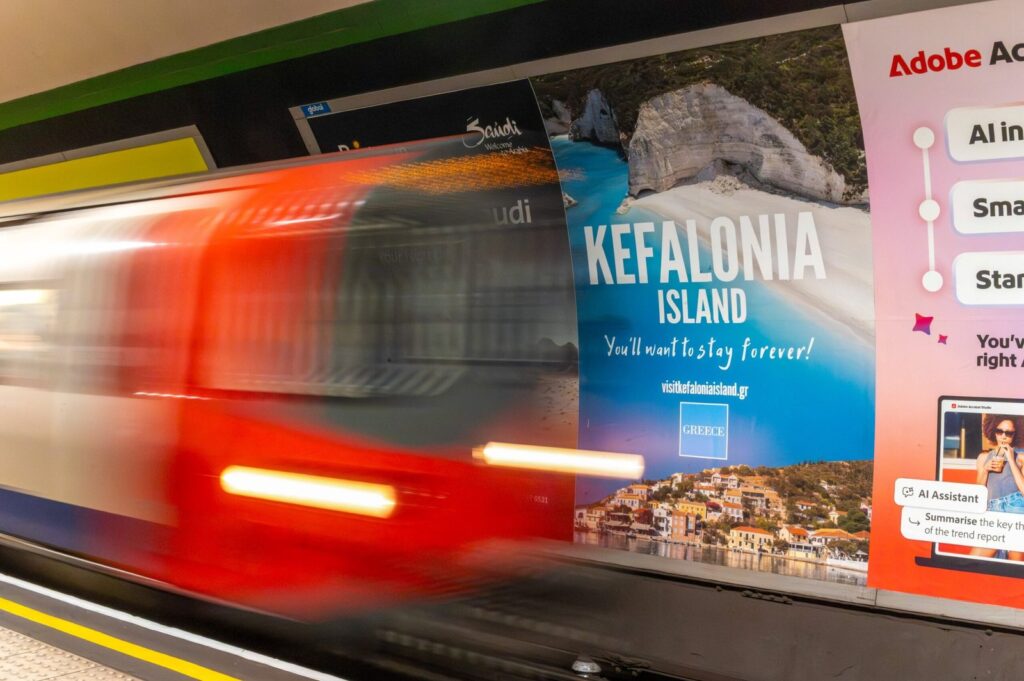
Large format posters on the wall directly opposite the platform, facing passengers across the track. The entire platform audience faces these for the duration of their wait. Three minutes of average platform dwell time with a large-format poster at eye level is a powerful combination.
- Price: from £1,000 per panel at outer zones
- Zone 1 stations: £1,500 to £2,800 per panel
- Best for: hero brand moments, product reveals, campaigns that need visual scale
48-sheet cross-track posters
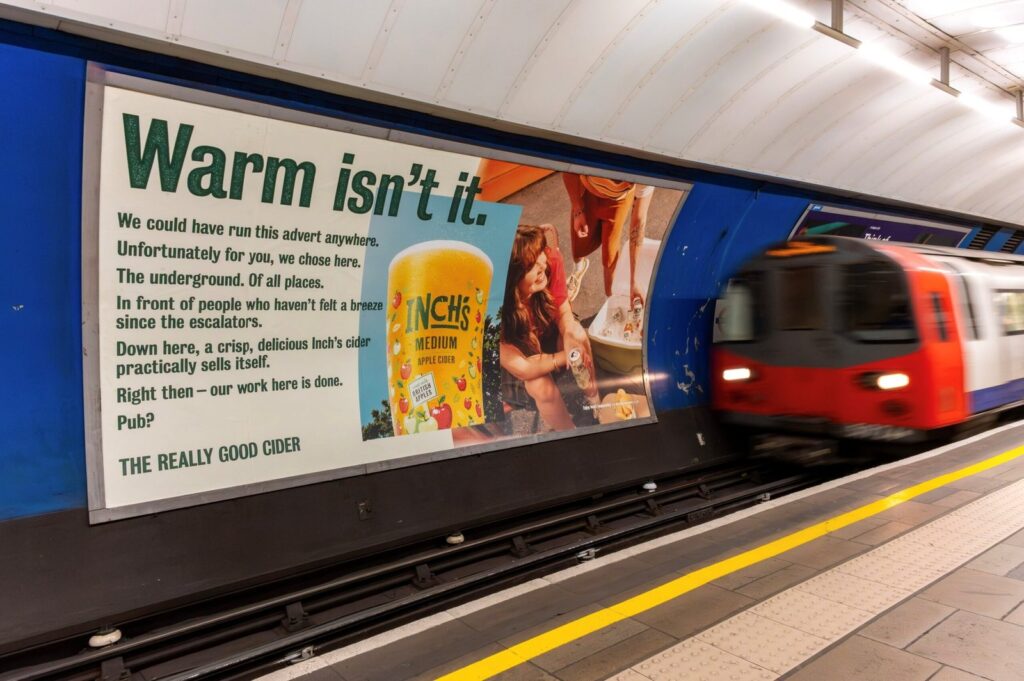
The largest static format on the Underground. Six metres wide and impossible to miss. Typically booked months in advance at key stations because availability is limited. This is the credibility-signalling format: your brand at scale in the heart of the London transport network.
- Price: from £1,500 per panel by station
- Zone 1: £2,500 to £5,000 per panel and above
- Best for: major launches, brand repositioning, campaigns where presence is the message
Digital escalator panels and ribbons
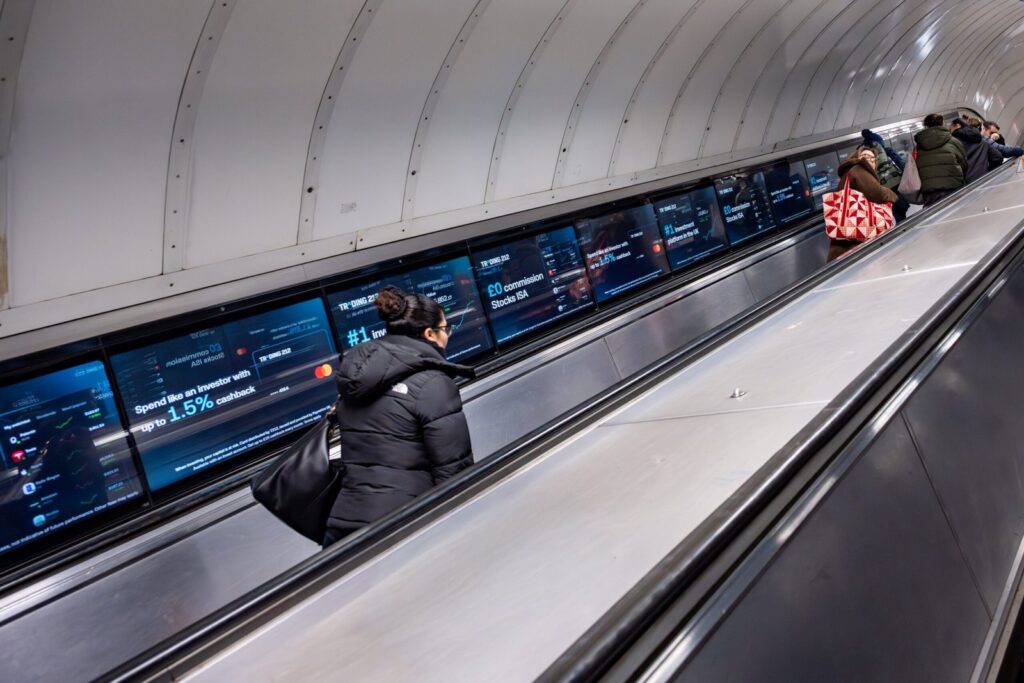
Full-motion video capability on escalator banks at premium locations. Daypart targeting available, programmatic buying possible. The most technically sophisticated format on the Underground and the one that generates the strongest engagement data.
- Price: from £15,750 per week
- Full-motion capability with unique capabilities
- No print production costs
- Best for: brand campaigns and product launches where motion adds meaning
Full-motion ads on the Underground deliver around four times the engagement of equivalent static formats, according to industry research. For campaigns where engagement matters more than pure reach, the premium is often justified.
Station dominations and takeovers
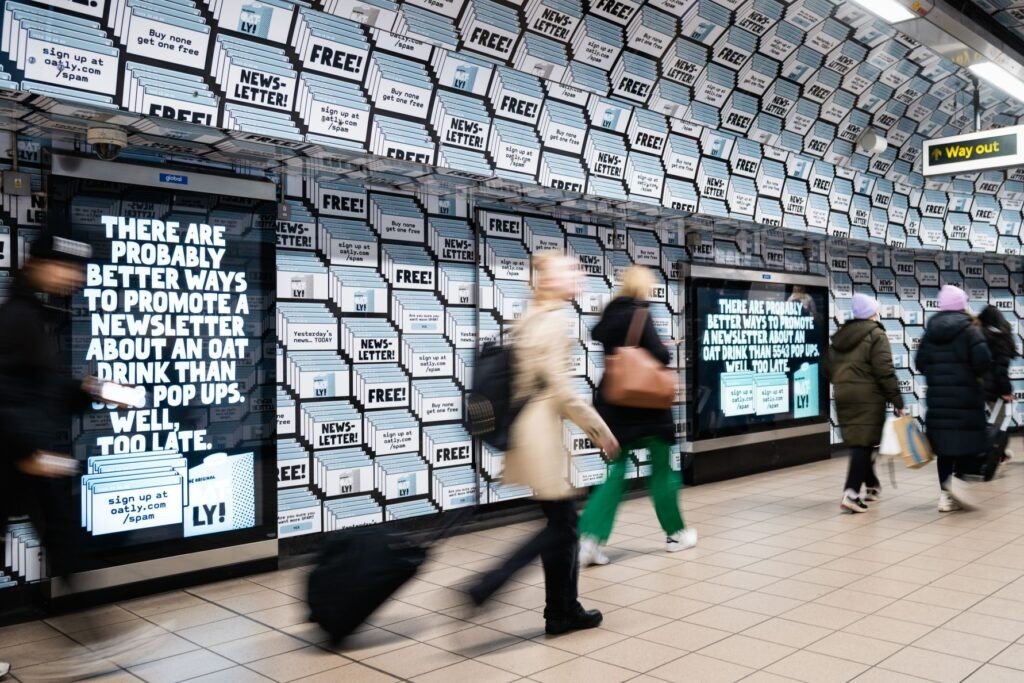
Total brand experience across all advertising surfaces within a single station. Posters, digital screens, escalators, ticket halls, platforms, corridors: everything carries your campaign. Key hubs available include Oxford Circus, Waterloo, King’s Cross, and Victoria.
- Price: from £15,000 for a two-week period at smaller stations
- Flagship stations (Oxford Circus, King’s Cross, Victoria): £50,000 to £100,000 and above
- Plan 3 to 6 months ahead for premium locations
- Best for: major product launches, rebranding, campaigns where saturation is the strategy
Station dominations reliably generate social media coverage and press interest. If the creative is strong, a takeover at a major interchange becomes a news story in its own right.
London Underground format pricing summary (2026, two-week campaign, media cost only, excl. VAT)
| Format | Price from | Notes |
| Tube car panel (TCP) | £10 per panel | Line-based pricing. 20 min avg dwell. |
| Escalator panel (LEP/DEP) | £125 per panel | £300-£600+ at Zone 1 interchanges. |
| 4-sheet platform poster | £300 per panel | Zones 4-6. Zone 1: £400-£600. |
| 16-sheet cross-track | £1,000 per panel | Outer zones. Zone 1: £1,500-£2,800. |
| 48-sheet cross-track | £1,500 per panel | Zone 1: £2,500-£5,000+. |
| Digital escalator/ribbon | £15,750 per week | Full-motion. No print cost. |
| Station domination | £15,000 for 2 weeks | Flagship stations: £50k-£100k+. |
Source: Loud! OOH UK OOH Pricing Page
What a real campaign looks like at different budget levels
Individual format prices are useful. But what does a real campaign actually look like? Here is how I would think about budget bands in practice.
Under £5,000: test and learn
At this level you are working with a limited number of sites, probably along a specific line or in a specific zone. A handful of 4-sheet platform posters at outer zone stations, or a small run of escalator panels at a lower-footfall location. Enough to run a real Underground campaign and understand how the format works for your brand. Not enough for significant reach. Treat it as a proof of concept.
£5,000 to £20,000: genuine campaign territory
This is where Underground advertising starts to make proper sense. At this level you can buy a multi-station run of platform posters, or combine escalator panels with cross-track placements at a specific station. A £10,000 budget spent on four or five well-chosen Zone 2 stations over two weeks will generate meaningful brand exposure with the right audience.
£20,000 to £60,000: integrated multi-format
Multiple formats across multiple stations, potentially across multiple lines or zones. Tube car panels for frequency, platform 48-sheets for impact, digital screens for flexibility. A properly planned campaign at this level can reach a significant slice of the London commuter audience over a two-week period.
£60,000 and above: domination and major launch territory
Station dominations, digital escalator takeovers at high-footfall locations, or multi-format campaigns running simultaneously across multiple central London stations. This is where major product launches, brand repositioning, and campaigns where the Underground itself becomes part of the narrative live.
The factors that move the price
Underground advertising prices are not fixed in the way a rate card implies. Several things move the cost in either direction, and knowing them before you go to market makes a real difference.
Zone
Zone 1 commands a significant premium over outer zones. The same format at Oxford Circus costs substantially more than the equivalent at a Zone 4 station. That premium reflects footfall and audience concentration. For many SME campaigns, outer zone inventory offers better value than chasing Zone 1 sites at twice the price.
Station category and footfall
Stations are tiered by footfall and demand. Premier stations like King’s Cross, Victoria, Waterloo, Oxford Circus, and Paddington command the highest prices. If your audience is concentrated in a specific part of London, buying fewer high-quality sites in the right location consistently outperforms scattering budget across cheaper stations where your target audience is not present.
Time of year
Q4, specifically October through December, is the busiest and most expensive period. Christmas campaigns, retail pushes, and Black Friday all compete for the same inventory. Expect to pay a premium and to need to book months in advance. January through March and mid-July through August are quieter with better availability and occasionally better rates. Loud! OOH data shows Q4 costs typically run 10 to 25% above the equivalent off-peak period.
Campaign duration
The standard booking cycle is two weeks. Longer campaigns cost more in total but less per week. A 12-week booking typically runs 20 to 30% below the equivalent two-week rate on a per-week basis. If you know you want sustained presence, committing to a longer run upfront almost always works out cheaper than returning to market repeatedly for short bookings.
Volume
Booking multiple formats or multiple stations in a single campaign gives you negotiating leverage. Three or more sites typically unlocks 5 to 20% volume discount depending on total spend. This is one of the real advantages of working with a buying agency that has volume relationships with Global, the sole media owner for Underground advertising under its TfL contract.
Does it work? The honest answer on effectiveness.
The reach statistics are impressive. But reach does not equal results. Here is what the evidence actually says, and where the limitations are.
Recall rates
Research cited by industry sources attributed to Transport for London data suggests that around 82% of Underground passengers notice advertising on platforms, with 73% recalling specific brand messages days after exposure. Loud! OOH’s compiled 2026 market data puts overall OOH ad recall at 79% at 30 days. For context, these figures significantly exceed typical digital display advertising recall, which regularly comes in below 30%.
The captive environment is a genuine advantage. Passengers are not scrolling past your ad. They are standing on a platform facing it, or sitting in a carriage with it in their eyeline for the duration of the journey.
Digital versus static: the real comparison
Full-motion digital ads on the Underground deliver around four times the engagement of static equivalents according to industry research. For campaigns where engagement matters more than sustained presence, that is a compelling number. But static formats are visible 24 hours a day for the full campaign duration without competing for screen time, and they consistently deliver better cost per impression for brand-building objectives. The right choice depends on what you are trying to achieve, not on which format sounds more impressive.
What it does not do well
The Underground is a brand awareness format. It builds recognition, familiarity, and salience over time. It is not a direct response channel. You can include a QR code or URL, and some brands do this successfully, but expecting a flood of direct conversions from Underground advertising alone is a misunderstanding of the format.
It also does not work well for highly localised targeting below the station level. If your business serves a very specific neighbourhood, bus shelter advertising around that area will be cheaper and more geographically precise than an Underground campaign.
The Underground works best when you want Londoners to know your brand exists, to have seen it, to feel like it is part of the city. That is a legitimate and valuable marketing objective. Just be clear about what you are actually buying before you commit.
Choosing the right stations: a practical framework
Most guides tell you which stations exist but not how to actually choose between them for a specific brief. Here is how I approach station selection for different campaign types.
Targeting London professionals, B2B, or financial services
Bank, Canary Wharf, Moorgate, Liverpool Street, Aldgate. Morning rush hour on weekdays. These are the financial district commuter routes where ABC1 professional concentration is highest. Over 70% of passengers at key financial stations hold professional qualifications. The income and decision-making skew is meaningful for B2B campaigns and premium consumer brands.
Targeting consumers aged 18 to 34
Old Street, Brixton, stations near university campuses like Russell Square and Goodge Street. Evening and weekend footfall. This audience is harder to reach through traditional media and responds well to brands with genuine creative personality. The 18 to 34 group represents over 60% of passengers at university-adjacent stations.
Targeting tourists and leisure spenders
Leicester Square, Covent Garden, Piccadilly Circus, Oxford Circus. These stations see 20 to 30% international visitor footfall during peak tourism months. Good for hospitality brands, entertainment, experiences, and consumer goods with international appeal.
Targeting affluent residential London
South Kensington, Sloane Square, Notting Hill Gate, Hampstead. Higher-income residential catchments. Useful for luxury goods, premium financial products, high-end hospitality, and residential property.
Maximising reach without Zone 1 prices
Zone 2 and 3 stations on high-volume lines offer genuinely competitive reach at a significant discount to Zone 1. Stratford, Bethnal Green, Angel, Clapham Common, and others. You are still reaching large numbers of London commuters but at a fraction of the premium. For first-time Underground advertisers, this is often where the money goes furthest.
The booking process: what actually happens
Guides often skip this. Here is what the process looks like from brief to live campaign.
Lead times
Allow a minimum of three to four weeks from brief to campaign live for standard static formats. Digital formats can sometimes move faster, but artwork still needs TfL approval, which typically takes three to five working days. Premium formats and station dominations need four to eight weeks minimum. Popular Zone 1 stations in Q4 can be booked out months in advance.
TfL approval
All artwork must be approved by Transport for London before going live. TfL’s advertising policy prohibits content that could cause serious or widespread offence, promotes negative body images, or relates to certain restricted product categories. The CAP Code also applies. This is not a barrier for most campaigns but worth knowing before creative work is commissioned.
Print production costs
For static formats, factor in print production separately from media costs. Escalator panel and 4-sheet production varies by format and supplier. Tube car panels include print in the standard pricing. Digital formats carry no print cost. For small campaigns, print production can represent a meaningful proportion of total spend and should be budgeted for upfront.
Is London Underground advertising right for an SME?
Straight answer: it depends on what you are trying to achieve and whether your audience genuinely lives on the network.
The default assumption is that Underground advertising is only for big brands with big budgets. That is not accurate. Entry-level campaigns using platform posters at outer zone stations or tube car panels along specific lines are achievable at budgets that many SMEs operate with. But clarity about the objective matters.
When it makes sense for a smaller business
- Your target customer is a London professional and the Tube is part of their daily routine
- You are launching in London and need the city to know you exist
- You have a strong creative concept the format can do justice to
- Your marketing mix includes digital channels to capture search interest generated by the awareness campaign
- You want sustained visibility with a specific London audience over a two to four week period
When to think twice
- You need immediate, trackable conversions rather than brand awareness
- Your target audience is not primarily London-based
- Your budget does not allow for proper creative development alongside media spend
- You are targeting a specific neighbourhood rather than a broader London commuter audience
One thing I would always say: do not run a small Underground campaign with weak creative. The environment is high quality. Poorly executed creative in a premium setting does not just underperform, it creates a negative brand impression. If you are going on the Tube, the creative needs to be ready for it.
My view: for an SME with a genuine London audience, a clear awareness objective, and a modest but well-directed budget, the Underground is absolutely worth considering. Start with a small test at Zone 2 or 3 stations, run it properly, and build from there.
How to get more from your budget
A few things that consistently make Underground campaigns work harder.
Be specific about stations
Ten sites at the right stations will outperform twenty sites at the wrong ones every time. Resist the urge to spread budget thinly for the sake of appearing larger. Three or four well-chosen locations where your specific audience actually is will consistently outperform scattered coverage at a higher total site count.
Book off-peak periods when timing is flexible
January, February, and the summer months offer better availability and occasionally negotiated rates, particularly at premium locations that are fully committed in Q4. If your campaign is not time-sensitive, planning around quieter inventory windows can extend your budget significantly.
Commit to longer campaigns when possible
A 12-week booking typically costs 20 to 30% less per week than the equivalent two-week booking. Regular commuters build familiarity with a brand across repeated exposures during a sustained campaign. If you can commit upfront, do it.
Use the format’s specific strengths in the creative
Escalator panels are sequential. Write a story across them. Tube car panels have 20 minutes of dwell time. Use copy that people can actually read during the journey. Platform posters need to work from across the track. Make them bold, simple, and readable at distance. The brands that consistently get the best results are the ones whose creative was designed for the format rather than adapted from something else.
Combine with digital to capture interest
There is good evidence that Underground advertising drives online search behaviour. Running a digital search campaign alongside your Underground activity to capture branded search interest generated by the awareness campaign consistently improves measurable return. The two formats work together better than either does in isolation.
Frequently asked questions
How much does it cost to advertise on the London Underground?
Based on Loud! OOH’s 2026 rate card, entry-level Underground advertising starts from £10 per tube car panel or £300 per 4-sheet platform poster at outer zone stations, rising to £15,000 or more for a two-week station domination at a smaller location and £50,000 to £100,000 and above for flagship stations. A realistic first campaign for an SME wanting genuine visibility across five to ten sites in a specific zone would typically cost between £5,000 and £15,000 for two weeks, including print production but excluding creative. We publish our full rate card openly at loudooh.co.uk/pricing. No forms, no callbacks.
How long does it take to get a campaign live?
Allow a minimum of three to four weeks from brief to campaign live for standard static formats. For digital formats, then within 24 hours if the artwork has been approved. TfL artwork approval takes three to five working days. Production and installation typically adds a further week. Book significantly earlier for Q4 campaigns, where availability at premium stations is limited.
Can a small business afford to advertise on the London Underground?
Yes. Although there is a £1,000 minimum spend and some formats have minimum order quantities. Tube car panels are booked by a minimum of 580 posters. A small business with a London audience and a budget of £5,000 to £10,000 can run a meaningful Underground campaign across a handful of well-chosen sites. The key is targeting the right stations rather than trying to achieve broad reach on a small budget.
How do I measure whether it worked?
Brand tracking research before and after the campaign is the most reliable measure of awareness impact. Campaign-specific URLs and QR codes can track direct response, though the Underground is primarily an awareness format. Please note that QR codes cannot be used on certain formats including, Tube Car Panels and any Cross Track Posters due to health and safety concerns. Advertisers can monitor branded search volume in Google Search Console during and after campaigns, which frequently shows uplift from Underground activity even when direct response tracking is not in place.
What content restrictions apply?
TfL’s advertising policy prohibits content that causes serious or widespread offence, promotes negative body images, or relates to certain restricted categories. The CAP Code applies to all Underground advertising. All artwork must be submitted for TfL approval before going live, typically three to five working days ahead of the campaign start date.
Is digital or static Underground advertising better?
It depends entirely on the objective. Digital formats allow dynamic content, daypart targeting, and no print cost, and deliver higher engagement for motion-led creative. Static formats offer sustained 24-hour presence, proven cost efficiency for brand building, and often better cost per impression over a full two-week campaign. The best campaigns often combine both rather than choosing one over the other.
Final thoughts
London Underground advertising earns its reputation. The audience is large, affluent, and captive, and the dwell time is unlike any other OOH format. If you are a brand with a London audience and a story worth telling, the Underground should be on your radar.
The mistake most first-time Underground advertisers make is not choosing the wrong format. It is choosing the wrong stations, underinvesting in creative, or expecting direct response from a brand awareness channel. Get those three things right and the format will consistently deliver.
At Loud! OOH we plan and buy London Underground campaigns for SMEs and challenger brands across the UK. We do not mark up media costs and we publish our pricing openly so you know exactly what you are getting before you commit.
See our full London Underground pricing at View our pricing or contact us at hello@loudooh.co.uk or 020 4514 9147.
Sources referenced in this article
1. Transport for London: Underground services performance data
2. Wikipedia: List of busiest London Underground stations (2025 data)
3. Wikipedia: London Underground
4. Statista: Passenger journeys on the London Underground
5. Media.co.uk: London Underground audience and recall research